Wu Wei: The Art of Not Forcing
🇩🇪 Auf Deutsch lesen~12 min read
philosophydaoismpracticedesignPart of the Philosophy section — a companion to Minimal Stoic Unix and We Know More Than We Can Tell.
Framing: A Short History of Philosophy
The cook in Zhuangzi's most famous story has been carving oxen for nineteen years, and his blade is as sharp as the day it was forged. Asked how, he says he does not hack at the meat. He follows the natural grain, finds the spaces between the joints, and lets the blade pass through where there is already an opening. "There are spaces between the joints," he says, "and the blade has no thickness. If you insert what has no thickness into such spaces, there is plenty of room." The knife stays sharp because it never forces.
Wu wei is not the absence of action. It is action that has stopped fighting the grain of the situation.
That story is the best introduction to wu wei (無為) — usually translated as "non-action," which is misleading, and sometimes as "effortless action," which is better but still too easy. The phrase from the Dao De Jing is wei wu wei (為無為): to act without acting, to do without forcing. It is one of the oldest ideas in Chinese philosophy and one of the most persistently misunderstood. In the modern West it gets sold as a productivity hack, a justification for passivity, or a vague instruction to "go with the flow." None of these is the thing itself.
It is not laziness. The cook is not idle; he is doing something extremely difficult with an ease that took decades to earn. Wu wei is the grace of mastery, not the absence of effort. The effort has been absorbed into the skill until it no longer shows.
It is not passivity. The sage in the Dao De Jing does not withdraw from the world; the sage governs, teaches, and acts. What changes is the mode of action: not coercion, not forcing, not the anxious over-management of outcomes, but a responsiveness that lets things unfold according to their nature.
It is not a productivity trick. The point is not to get more done with less stress. The point is to act in accordance with the way things are — and that sometimes means doing less, sometimes waiting, sometimes refusing to intervene. Efficiency is a side effect, not the goal.
And it is not a license to abdicate. This is the most important distinction, and the one most often lost. Wu wei is a discipline of attention, not an excuse for neglect. The cook is paying exquisite attention. The ruler who steps back has first built the conditions under which stepping back is safe. Non-forcing without attention is just indifference with better branding.
The Dao De Jing, traditionally attributed to Laozi, returns to the idea from several angles. Chapter 37: "The Dao never acts, yet nothing is left undone." Chapter 48: "Learning consists of adding; the Dao consists of subtracting. Subtract and subtract again until you reach non-action. Non-action, yet nothing is left undone." Chapter 63 gives the phrase directly: "Act without acting, work without working, taste without tasting."
The image that carries it best is water. Chapter 8: "The highest good is like water. Water benefits all things and does not compete." Chapter 76: "The soft overcomes the hard; the weak overcomes the strong." Water does not fight the rock. It finds the way around, wears it down over time, and takes the shape of whatever holds it. This is not weakness; it is a different kind of strength — the strength of alignment rather than impact.
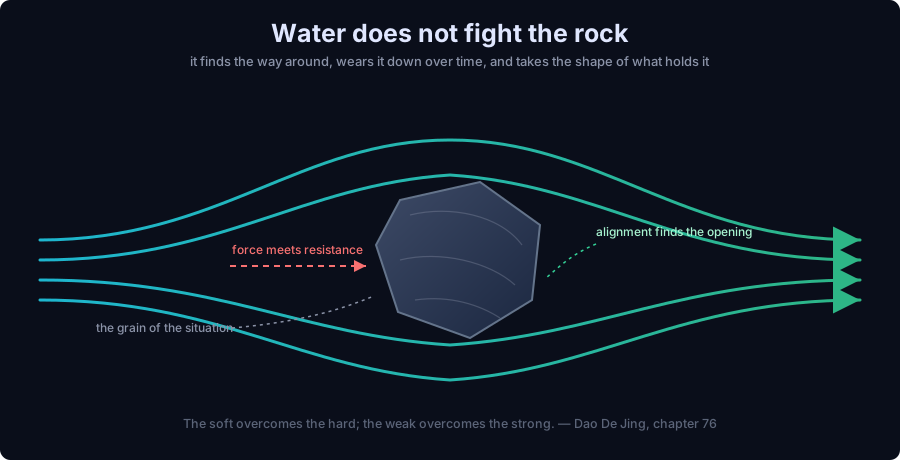 Water does not fight the rock: streamlines bend around a boulder instead of forcing it
Then there is emptiness, the idea that gives the essay its practical spine. Chapter 11 points out that we shape clay into a pot, but it is the emptiness inside that makes it useful; we build walls and cut doors and windows, but it is the empty space that makes the room livable. The useful part is what is not there. This is a design principle disguised as cosmology. A system with no slack, no headroom, no empty space, is not efficient; it is brittle. The usefulness of a thing includes the room it leaves.
And chapter 17 gives the political version, which is also the infrastructure version: the best ruler is barely noticed. When the work is done, the people say, "We did it ourselves." Good government, like good plumbing, is judged mostly by its absence.
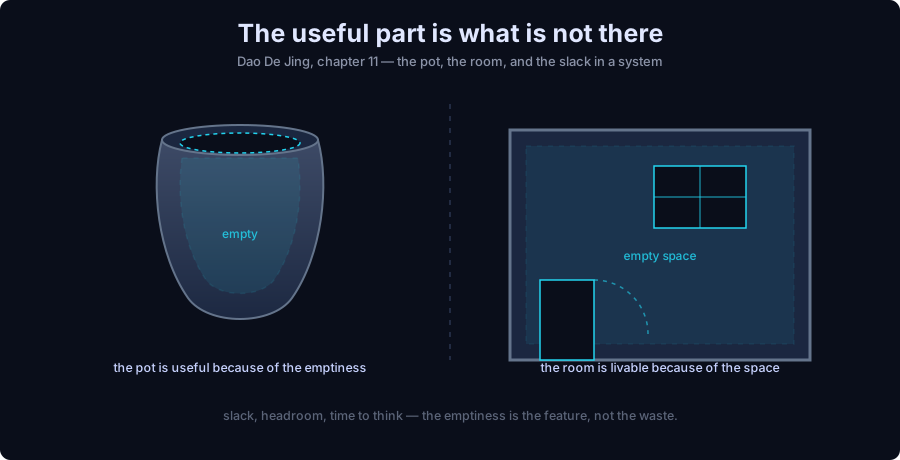 The useful part is what is not there: the hollow of a pot and the empty space of a room
Zhuangzi, the other great Daoist text, is less aphoristic and more playful, and it adds two images that matter for builders. The first is the useless tree. A carpenter passes by a huge, gnarled tree and ignores it because its wood is good for nothing. The tree survives precisely because it cannot be used. Zhuangzi's point is not that uselessness is a strategy for avoiding work; it is that the world's accounting of "useful" is narrow, and that fitting too neatly into a use can destroy the thing that is being used. The tree that is good for everything is good for nothing — including staying alive.
The second is the fish trap. "The fish trap exists because of the fish; once you have gotten the fish, you can forget the trap. The rabbit snare exists because of the rabbit; once you have gotten the rabbit, you can forget the snare. Words exist because of meaning; once you have gotten the meaning, you can forget the words." Tools are for results. When the result is achieved, the tool should be allowed to recede. This is the same insight Heidegger would later make central in the West: the good tool disappears in use. The bad tool is the one you keep noticing.
Zhuangzi's "hinge of the Dao" is the third image: stand at the center of the circle and respond to whatever comes, without fixing yourself to one position in advance. Not because you have no view, but because a fixed position cannot respond to a moving world. The hinge turns with the door.
Here is the tension that makes wu wei more than a slogan. It sounds like the opposite of effort, but it is actually the fruit of effort. The cook's ease is built on nineteen years of practice. The expert's fluidity is the residue of thousands of hours of deliberate work. You cannot decide to be effortless; you can only become effortless by first being clumsy, then competent, then fluent.
This is why wu wei belongs next to the tacit-knowledge tradition. The cook cannot fully explain what he does — he can point to the grain, but the ability to feel it lives in his hands. Polanyi's sentence applies: he knows more than he can tell. The Daoist sage and the Dreyfus expert are describing the same phenomenon from different vocabularies: a skill so deeply absorbed that it no longer presents itself as a sequence of decisions.
The paradox has a practical consequence. You cannot skip the rules to reach the grace. The novice needs the rulebook; the expert has internalised it and moved past it. Wu wei is not the beginner's shortcut. It is the advanced practitioner's reward — and it is only available to someone who has done the unglamorous work.
The idea translates surprisingly well into engineering, because so much of good system design is subtraction.
Negative space. Chapter 11 is a systems principle: the empty part is the useful part. Headroom, slack, idle capacity, time to think, a buffer against the unexpected — these look like waste on a spreadsheet and behave like resilience in a crisis. A system with no emptiness cannot absorb anything new. A calendar with no gaps cannot hold a conversation. A team with no slack cannot respond to an incident.
Invisible infrastructure. Chapter 17 is the platform engineer's creed. The best infrastructure is the infrastructure nobody notices. When it works, the product teams say, "We built this ourselves." That is not ingratitude; it is the highest compliment a platform can receive. The goal is not to be indispensable. The goal is to make the right thing easy and then get out of the way.
Subtraction before addition. Chapter 48: subtract and subtract again. The instinct of most builders is to add — a new service, a new abstraction, a new config flag, a new rule. Wu wei asks the opposite question first: what can be removed? What is the simplest arrangement that lets the situation work? Fuller's ephemeralization and the minimal-stoic-unix instinct are cousins of this move: do more with less, not because less is virtuous in itself, but because less is easier to understand, to maintain, and to trust.
Timing. Water does not force the rock; it arrives, again and again, at the right angle. Much of engineering is timing: knowing when to ship, when to wait, when to refactor, when to leave a working system alone. The forced move — the premature rewrite, the rushed migration, the intervention before the situation is ready — usually costs more than the patient one. Wu wei is not passivity; it is knowing when the grain is ready to be followed.
The temptation with AI is to read wu wei as a justification for automation: let the system act without acting, let it do the work, step back. That reading is seductive and wrong. Automation is action without an agent. Wu wei is an agent acting without forcing. The difference is responsibility.
A model can generate without intention, but that is not wu wei; it is just generation. The cook's non-forcing is meaningful because there is a cook — someone who has practiced, who is paying attention, who can be wrong and can adjust. Strip out the practitioner and you are left with a machine that produces output, not a sage who acts in accordance with the way.
The useful version of the idea is about design stance, not delegation. Instead of trying to force the system with more rules, more prompts, more constraints, ask what conditions would let it find the grain. Instead of over-specifying every step, design the feedback loop and the boundaries, then observe. This is closer to gardening than to commanding. It is also, not coincidentally, closer to how the best human teams actually work.
But the shadow is real. "Let the model decide" can be wu wei or it can be abdication, and the difference is whether you remain attentive and accountable. The Dao De Jing's ruler who steps back has first built the conditions for safety. The engineer who says "the system knows best" has usually built nothing of the kind. Non-forcing is a discipline of responsiveness. Neglect is the absence of response. They can look identical from the outside, and they are opposites on the inside.
The Daoist tradition has always had a political risk, and it is worth naming. A philosophy of non-forcing can be used by the powerful to discourage resistance: be still, do not struggle, let things unfold. The third-century BCE Confucian Xunzi made exactly this criticism of Zhuangzi — that he ignored the necessity of human effort and social norms, and that his freedom was purchased at the cost of responsibility.
The criticism is not decisive, but it is a real warning. Wu wei is not the same as acceptance of injustice. The cook does not force the meat, but he does cut it. The sage does not coerce, but the sage does act. The test is whether the non-action is responsive — whether it is based on attention, skill, and care — or whether it is simply the refusal to look. "Let it be" is wu wei only when you have first understood what it is you are letting be, and why.
The idea is easy to nod at and hard to live. A short practice, in the spirit of the section:
The cook's knife stays sharp because it never forces. The pot is useful because it is empty. The room is livable because of the space between the walls. The ruler is loved because the people forget he is there. These are not separate images; they are one idea seen from different angles: the way works best when it is not fighting itself.
That is the discipline wu wei asks of us — not to do nothing, but to stop doing the unnecessary thing, the forced thing, the thing that adds effort without adding life. It is the hardest kind of restraint, because it looks like doing nothing and requires knowing a great deal. The cook earned his ease. The rest of us are still learning where the spaces are.