The Tool Vanishes: Heidegger, Equipment, and the Infrastructure We Only See When It Breaks
🇩🇪 Auf Deutsch lesen~10 min read
philosophyphenomenologytechnologyinfrastructurePart of the Philosophy section — a companion to We Know More Than We Can Tell and Words That Do Things.
Framing: A Short History of Philosophy
The most important thing about a hammer is that you do not see it. You see the nail, the board, the house you are building. The hammer is transparent — not because it is unimportant, but because it is working. Only when the head flies off the handle does the hammer become an object: a thing with a weight, a brand, a failure mode, and a replacement to order.
Martin Heidegger made this ordinary experience the starting point of Being and Time (1927), and in doing so gave us the most useful philosophy of infrastructure we have. His claim is not merely that we overlook tools. It is that the way a tool is differs from the way an object is. Equipment is defined by its place in a practice, not by its properties. And when it breaks, it does not simply stop working; it changes the kind of thing it is — and, for a moment, reveals the world it was serving.
A tool is not a thing among things. It is a way the world shows up — and a way the world hides.
This essay follows that thought from the workshop to the data center. Infrastructure is the hammer writ large: DNS, TLS, CI, the power grid, the package registry. We notice it when it fails, and we call the failure an outage. The cloud is a name for a workshop we have forgotten. And the current enthusiasm for autonomous agents is, among other things, a test of whether we can design equipment that stays honest about the world it gathers.
Heidegger's word for a tool is Zeug — equipment, gear, the stuff you use. The first thing to notice is that Zeug is never alone. A hammer points to nails, nails to boards, boards to a house, a house to the people who will live in it. Heidegger calls this the Um-zu structure: the hammer is in order to drive nails; the nails are in order to build; the building is in order to dwell. Equipment is intelligible only inside a referential whole — a Zeugzusammenhang — and that whole is what he calls the world.
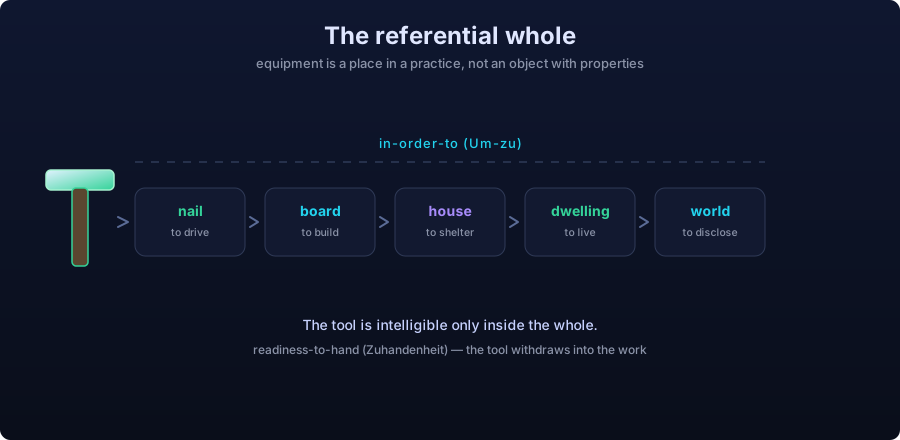 The referential whole: a hammer points through nails and boards to a house and a dwelling, and the practice is what makes it a tool
This is why the standard picture of a tool as a neutral object with a use is already a step too late. The hammer in the drawer is not more real than the hammer in your hand; it is less. Its being is its readiness for the task. When you are building, you do not experience the hammer as a bundle of properties. You experience the nail going in. The tool has withdrawn into the work.
The same is true of a keyboard, a text editor, a command line, a deploy pipeline. When they are working, they disappear into the sentence, the build, the release. You do not think about TLS handshakes while reading a page; you think about the page. The infrastructure is not the subject of the experience. It is the condition of it.
Heidegger describes three ways equipment can lose its readiness, and they are more useful than most incident taxonomies. A tool can be conspicuous when it is damaged — the hammer whose head is loose. It can be obtrusive when it is missing — the hammer that is not in the drawer when the work needs it. And it can be obstinate when something is in the way — the tool that will not fit, the interface that resists. In each case, the transparent equipment becomes present-at-hand (vorhanden): an object with properties, measurable and inspectable, standing over against a subject who now looks at it rather than through it.
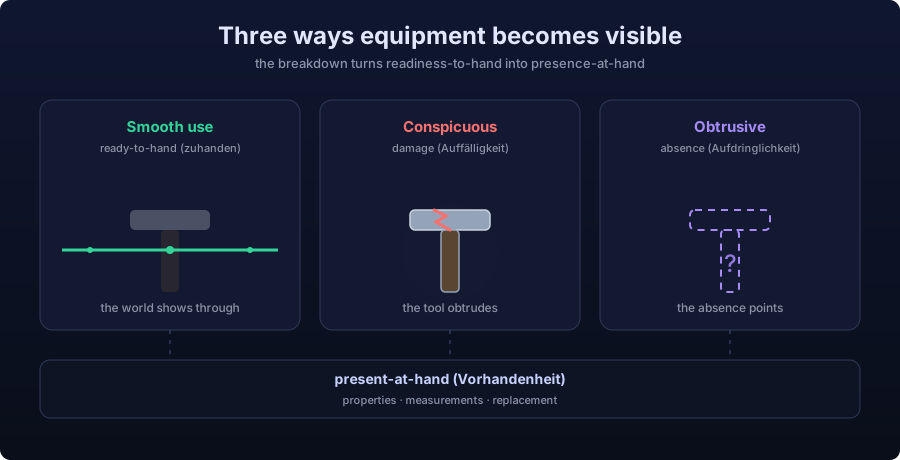 Three ways equipment becomes visible: smooth use, conspicuous damage, and obtrusive absence — and the object that appears in the breakdown
The breakdown is not just a failure. It is an ontological event. The world that the tool was serving becomes visible as a background: the nail, the board, the deadline, the person waiting. Theory begins here. The broken tool invites inspection, measurement, representation; the object under the microscope is the descendant of the hammer that stopped working. This is why Heidegger says that presence-at-hand is founded on readiness-to-hand, not the other way around. The detached observer is not the default human stance. It is what is left when a practice stumbles.
Operations is the discipline of living in this transition. On-call engineers are professional witnesses of breakdown: they see the ready-to-hand become present-at-hand, over and over, at three in the morning. Good observability tries to make the invisible visible without waiting for the hammer to break — traces, service-level objectives, synthetic probes, the quiet dashboard that tells you the tool is still transparent. A bad alert is a hammer that suddenly becomes an object; a good one is a window into the workshop.
The cloud is the most successful piece of invisibility engineering in the history of computing. It is designed to feel like a utility: you flip a switch, compute happens. Behind the switch is a workshop of enormous complexity — data centers, cooling, fiber, BGP, virtual machines, container runtimes, IAM, billing, and a great deal of human labor. The name "cloud" does not describe the thing. It describes the experience of the thing when it is working. It is a word for transparency.
Susan Leigh Star's ethnography of infrastructure puts the point precisely: infrastructure is by definition invisible, part of the background for other kinds of work; it becomes visible when it breaks, and then it tends to become visible as a problem. The ready-to-hand is not merely unnoticed; it is designed to be unnoticed. The best infrastructure is boring, and boredom is the aesthetic of a workshop that is running.
This has consequences for how we build. If the tool is a place in a practice, then its quality is not only in the tool. It is in the fit between the tool and the practice — the error messages, the escape hatches, the runbooks, the person who knows what to do when the dashboard goes red. A tool that works beautifully in the demo and fails opaquely in production has not been designed for the workshop. It has been designed for the showroom.
The current generation of AI systems invites a category error. A language model or an agent is presented as a subject: it "understands", "decides", "acts autonomously". The vocabulary of agency is seductive because it matches the fluency of the output. But a tool does not become a subject by becoming fluent. It becomes a more powerful tool — which is to say, a more consequential place in a referential whole.
The question to ask of an agent is not "is it intelligent?" but "what referential whole does it sit in, and who is accountable when the chain breaks?" A model that writes code is equipment in a practice that includes tests, review, deployment, users, and consequences. Strip away that whole and you do not get an autonomous author; you get a fluent hammer with no nails.
This is also where the tacit-knowledge problem returns. The model has read the manuals. It has not inhabited the workshop. It can describe the in-order-to structure with perfect grammar while remaining blind to the moment when the structure gives way. The fluency is the danger: it makes the tool feel ready-to-hand while the world it claims to serve is not actually there.
Heidegger's later essay, The Question Concerning Technology (1954), widens the lens. Modern technology is not just a collection of tools. It is a way of revealing the world — and its characteristic mode is Gestell, enframing. Things show up as Bestand, standing-reserve: resources on call, available to be optimized. The river is a power source. The forest is timber. The employee is human resources. The model is compute.
Enframing is not a moral failing of engineers. It is a tendency built into a certain way of seeing: the world as inventory. And it is genuinely powerful. The same attitude that turns a river into electricity also builds reliable grids and hospitals. The danger is not that we use tools. It is that we forget the workshop and see only stock — including ourselves.
The counter-movement is not a return to hand tools. It is Gelassenheit, releasement: letting things show up as what they are, rather than only as what they can be made to yield. In practice, that means asking what a system is for, who it serves, what it hides, and what it would mean to let the people inside it be more than resources. Heidegger's line from Hölderlin is not a consolation; it is a task: where danger is, grows the saving power also.
The conclusion is not "use fewer tools". It is to design and inhabit equipment with the workshop in view.
Design for legibility in breakdown. An error message is an ontology. It decides what becomes present-at-hand. Name the broken tool and the world it was serving: which request, which dependency, which user, which consequence. A good failure is a map, not an accusation.
Instrument the invisible. Traces, SLOs, synthetic probes, and cheap health checks make the ready-to-hand visible before it breaks. Observe the practice, not just the box.
Keep the workshop human. On-call rotations, pairing, blameless postmortems, and craft transfer are not overhead. They are how a team inhabits its equipment. A tool without a practice is a prop.
Treat models as equipment. Ask what referential whole an agent sits in, who is accountable for the chain, and what happens when it breaks. Do not mistake fluency for dwelling.
Resist the language of standing-reserve. "Resources", "headcount", "content", "engagement" are not neutral words. They decide what can be optimized and what can be ignored.
Practice releasement. Let the tool be a tool. Let the person be a person. The point of good infrastructure is not to disappear completely; it is to disappear in the service of a world worth appearing.
The hammer is not a thing among things. It is a way the world shows up — and a way the world hides. When it works, you see the house. When it breaks, you see the hammer. The ethical question is not whether to use tools. It is what we let appear while they work, and what we are willing to notice when they fail.
The cloud is a workshop we have forgotten. The model is a hammer that can talk. The task is the same as it has always been: to build equipment that serves a practice we can still name, and to remain the kind of people who can tell the difference between a tool that is working and a tool that is merely fluent.