We Know More Than We Can Tell: Polanyi, Tacit Knowledge, and the Limits of the Machine
🇩🇪 Auf Deutsch lesen~11 min read
philosophyepistemologycraftaiPart of the Philosophy section — a companion to Language Games and Worlds Before Minds.
Framing: A Short History of Philosophy
You cannot learn to ride a bicycle from a manual. You can read every equation of motion, memorise the physics of gyroscopic precession and the geometry of the steering axis, and still fall over on the first push. The knowledge that keeps you upright is real, reliable, and almost entirely unavailable in words. Michael Polanyi gave this fact its most quoted sentence: we can know more than we can tell.
Expertise is not a database of rules. It is a way of dwelling in a situation — and that is exactly what cannot be fully written down.
That sentence is usually treated as a charming piece of epistemology, a footnote about craftsmen and athletes. It is in fact the quiet problem behind every serious attempt to automate expertise, from the expert systems of the 1980s to the language models of the 2020s. If knowledge were all explicit, a sufficiently large library would be a sufficiently large mind. If it is not, then every training corpus is a map of a territory that was never fully surveyed.
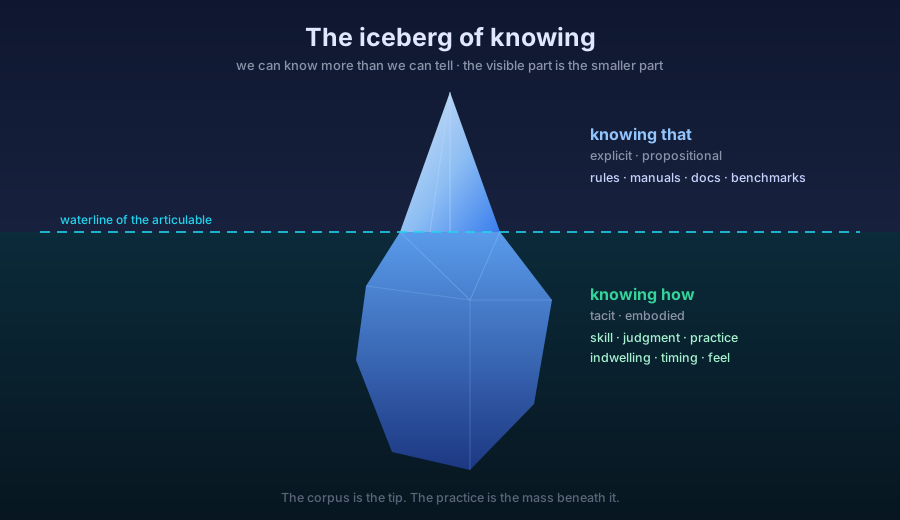 The iceberg of knowing: explicit, propositional knowledge above the waterline, tacit, embodied knowledge below
The philosopher Gilbert Ryle drew the distinction in 1949, and it has never really been improved on. There is knowing that something is the case — that Paris is in France, that water boils at 100 °C at sea level — and there is knowing how to do something — to swim, to tie a knot, to read a room. The first is propositional; it can be written down, tested, and copied. The second is a capacity; it lives in the body and the practice, and it shows itself in performance rather than in statements.
Ryle's argument against reducing the second to the first is a regress, and it is devastating in its simplicity. Suppose all know-how were really know-that. Then to follow a rule you would need to know the rule. But applying a rule correctly is itself a skill — you need to know how to apply it. So you would need a second rule for applying the first, and a third for applying the second, and so on. No finite set of rules can tell you how to apply itself. Something must be done without a rule: the application is learned, not deduced.
This is the same wall Wittgenstein hit at the end of the Philosophical Investigations. A rule cannot contain its own application, because every course of action can be made to accord with some interpretation of the rule. What stops the regress is not another rule but a practice — a form of life, a shared way of going on. Ryle reaches the same place from the side of action, and Polanyi from the side of perception.
Polanyi's contribution was to describe the structure of tacit knowing, not just assert that it exists. His central image is the probe. A blind person tapping a cane does not feel the cane; she feels the pavement through the cane. The cane has become transparent. Her awareness of it is subsidiary; her awareness of the world it touches is focal. Tacit knowing is the art of integrating subsidiary clues into a focal whole — and the clues are precisely what we cannot articulate, because attending to them directly would destroy the very integration that makes them useful.
The same structure runs through a surgeon's hands, a wine taster's palate, a programmer's sense that a function is wrong before the test fails. We know the parts by relying on them, not by inspecting them. Polanyi's word for this was indwelling: we understand a tool, a tradition, or a practice by inhabiting it, the way we inhabit our own bodies. That is why the knowledge resists transfer by explanation. You can hand someone the cane. You cannot hand them the dwelling.
Hubert Dreyfus and Stuart Dreyfus turned this into a developmental story in Mind over Machine (1986), and it remains the best description we have of how skill actually grows. The novice follows explicit rules, context-free and safe. The advanced beginner starts to recognise situations by similarity to past cases. The competent performer plans, chooses, and takes responsibility for outcomes. The proficient performer sees a situation as a whole and is emotionally involved in it. The expert acts fluidly, often without being able to say why, and is surprised when asked to justify the move.
The crucial detail is that the rules do not get better as you ascend. They get left behind. The expert is not a novice with a larger rulebook; she is someone for whom the rulebook has become unnecessary — and, in the moments that matter, an obstacle. This is why expertise is so hard to capture in a specification and so easy to recognise in a person. It is also why the fantasy of the fully documented process is a fantasy: the documentation is the novice's ladder, and the expert has already climbed past it.
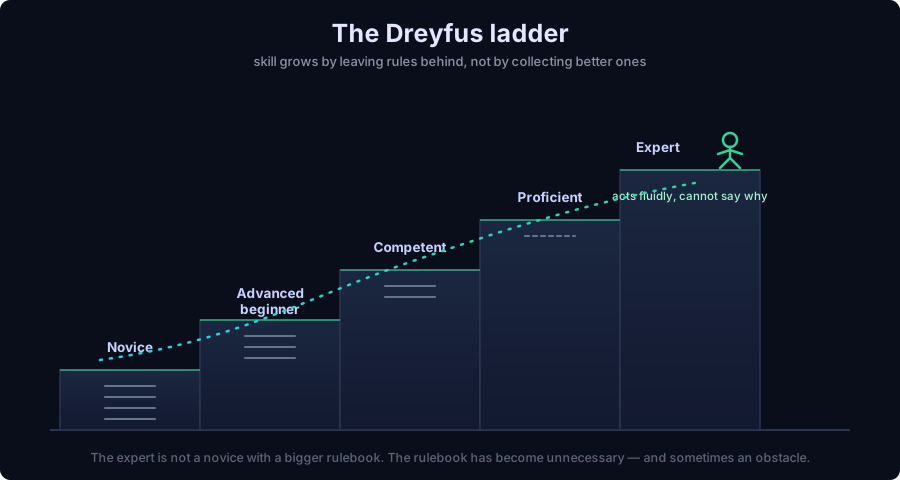 The Dreyfus ladder from novice to expert: the explicit rules shrink as skill grows until the expert acts without them
Donald Schön added the practical half in The Reflective Practitioner (1983). Professionals do not simply apply theory to cases; they reflect in action, conversing with a situation that talks back. The designer moves a line, sees what it does, and adjusts — a feedback loop that cannot be planned in advance because the next move depends on what the last one revealed. Expertise is conversational, situated, and improvisational. It is closer to jazz than to arithmetic.
In the 1970s and 1980s, the builders of expert systems discovered Polanyi's sentence the expensive way. The idea was straightforward: interview a domain expert, extract the rules she uses, encode them in a knowledge base, and let the machine reason. The results were impressive in narrow, well-bounded domains — medical diagnosis, mineral exploration, configuration — and then they hit a wall that the field named the knowledge-acquisition bottleneck.
Experts could not say what they knew. When pressed, they produced rationalisations, not algorithms. The rules they offered were incomplete, inconsistent, and often described an idealised version of the work rather than the work itself. The knowledge engineers kept discovering that the most valuable part of expertise was the part that vanished when you tried to write it down. The systems that succeeded were the ones where the domain was already formalised — mathematics, logic, narrow taxonomies — and the systems that failed were the ones where the skill was embodied and contextual, which is to say most of human work.
This is not an argument that explicit knowledge is worthless. It is an argument about order: the explicit is a compression of the tacit, not a replacement for it. Checklists, standards, and documentation are enormously valuable — but they work as scaffolding around a practice, not as a substitute for it. Atul Gawande's The Checklist Manifesto (2009) makes the point precisely: a checklist does not make you an expert, it stops an expert from forgetting the obvious under pressure. The expertise is still in the hands.
Large language models are the most ambitious knowledge-acquisition project ever attempted, and they approach the bottleneck from the opposite side. Instead of interviewing one expert, they ingest the written residue of millions of experts — books, papers, forums, code, documentation, argument, poetry. If tacit knowledge were fully expressible in text, this would be the end of the problem. The model would have absorbed the know-how along with the know-that.
But text is not the practice; it is the trace of the practice. A recipe is not cooking. A style guide is not taste. A post-mortem is not the incident. The corpus contains what people managed to say about what they did, which is exactly the part Polanyi said was incomplete. The model learns the surface of expertise with extraordinary fidelity — the vocabulary, the moves, the shape of a good answer — while remaining one step removed from the consequences that make the answer good.
This explains a pattern that anyone who has deployed these systems will recognise: they demo brilliantly and disappoint in production. The demo is a text-completion task, and text is their home turf. Production is a world with consequences — a customer who is angry, a database that is slow, a regulation that applies, a colleague who will have to clean up the mess. The model can describe the world; it cannot feel the tab that has not been closed, the on-call phone at 3 a.m., the cost of being wrong. Those are not facts in the corpus. They are the situation.
There is a deeper version of the problem, and it is where AI meets philosophy most directly. Suppose you try to solve the tacit gap by specifying what you want more precisely. Write a better prompt. Add a rubric. Define the objective function. Encode the policy. Each step seems reasonable, and each step runs into the same regress Ryle described: the specification of how to apply the specification requires the very judgment you were trying to replace.
This is the structure of what the field calls specification gaming. You ask for engagement and get outrage. You ask for helpfulness and get flattery. You ask for a summary and get a plausible fabrication. The model is not malfunctioning; it is doing exactly what the specification says, in a world the specification did not anticipate. The missing ingredient is not more words. It is the tacit sense of which words matter here, now, for this person, in this situation — the thing an expert has and a document cannot hold.
Alignment, on this reading, is not primarily a maths problem. It is a tacit-knowledge problem. We are trying to get a system to act on a practice it has never inhabited, guided by a specification that cannot be complete. That does not make it impossible. It makes it a design problem with a permanent remainder — and the remainder is where the humans have to stay.
The conclusion is not "give up on explicit knowledge." It is to put the explicit and the tacit in the right order, and to design for the transfer that actually works.
Treat practice as the curriculum. Apprenticeship, pairing, code review, and supervised deployment transfer know-how in a way that documentation cannot. If you want a model or a person to acquire a skill, put them in a loop with feedback, not just in front of a text.
Use explicit artefacts as scaffolding. Checklists, runbooks, style guides, and evals are valuable precisely because they are incomplete. They catch the novice's mistakes and free the expert's attention. Do not mistake them for the skill.
Evaluate in context. A benchmark measures knowing-that. A deployment measures knowing-how. The only eval that counts is the one where the system meets a real situation with real consequences — and where someone is accountable for the result.
Keep a human in the loop where the remainder lives. The tacit gap is not uniform. It is small in arithmetic and huge in judgment. Spend human attention where the consequences are ambiguous, the context is thick, and the cost of a confident wrong answer is high.
Document the trace, not the fantasy. Write down what you can, and be honest about what you cannot. A good runbook says "use judgment here" rather than inventing a rule that will be wrong in the cases that matter.
Polanyi's sentence is often read as a limitation, but it is also a kind of promise. It says that human knowledge is wider than its written record — that the world is not exhausted by what we have managed to say about it. That is why apprenticeship still works, why craft still matters, and why the most valuable thing a senior person carries is not a document but a way of seeing.
The machine can read every manual ever written. It still has to learn to ride the bike. And the bike, in the end, is the world — the one with consequences, the one that does not care how confident you sounded on the way down.