Graph Neural Networks: A Comprehensive Overview
Graph Neural Networks (GNNs) represent a powerful paradigm for learning on graph-structured data, enabling deep learning models to capture complex relational patterns in domains ranging from social networks to molecular chemistry.
What are Graph Neural Networks?
Graph Neural Networks are a class of deep learning methods designed to work directly on graph-structured data. Unlike traditional neural networks that operate on regular grids (images) or sequences (text), GNNs can process data with arbitrary graph topologies, making them ideal for:
- Social Networks: Analyzing user connections and influence patterns
- Molecular Structures: Predicting chemical properties and drug interactions
- Knowledge Graphs: Reasoning over structured knowledge bases
- Recommendation Systems: Learning user-item interaction graphs
- Traffic Networks: Predicting flow patterns and congestion
Core Concepts
Graph Representation
A graph G = (V, E) consists of:
- Nodes (V): Entities in the graph (users, molecules, items)
- Edges (E): Relationships between nodes (friendships, bonds, interactions)
- Node Features: Attributes describing each node
- Edge Features: Optional attributes describing relationships
Message Passing Framework
Most GNNs follow the message passing paradigm:
- Message Generation: Each node creates messages for its neighbors
- Aggregation: Messages from neighbors are aggregated (sum, mean, max)
- Update: Node representations are updated using aggregated messages
h_v^(l+1) = UPDATE(h_v^(l), AGGREGATE({h_u^(l) : u in N(v)}))
Where:
h_v^(l)is the hidden state of node v at layer lN(v)denotes the neighbors of node vUPDATEandAGGREGATEare differentiable functions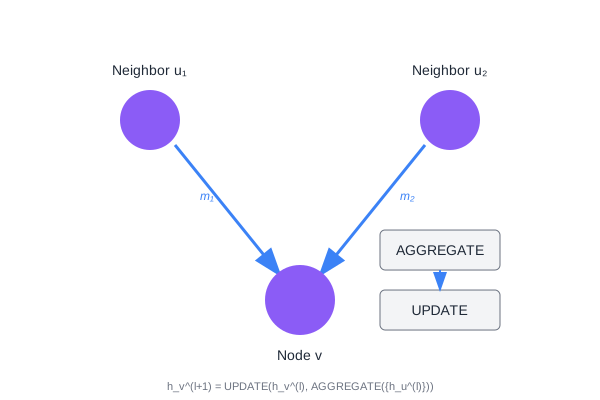
Message passing: nodes aggregate information from their neighbors
Key GNN Architectures
Graph Convolutional Networks (GCN)
GCNs extend convolutional operations to graphs by spectral or spatial methods. The layer-wise propagation rule:
H^(l+1) = σ(D^(-1/2) A D^(-1/2) H^(l) W^(l))
Strengths: Simple, scalable, effective for homophilic graphs Limitations: Over-smoothing in deep networks, limited expressiveness
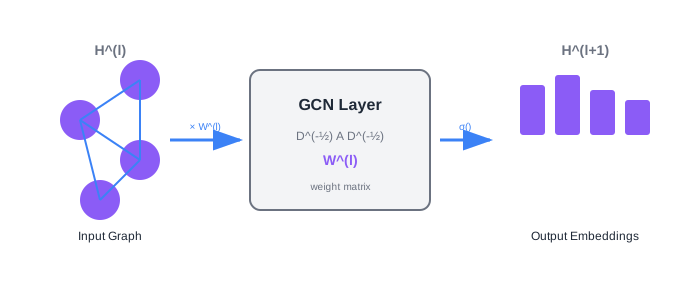
GCN layer computation: input graph transformed through weighted aggregation
Graph Attention Networks (GAT)
GATs introduce attention mechanisms to GNNs, allowing nodes to learn the importance of their neighbors:
α_ij = softmax(LeakyReLU(a^T [Wh_i || Wh_j]))
h_i' = σ(Σ α_ij Wh_j)
Strengths: Adaptive neighbor weighting, interpretable attention weights Limitations: Computationally expensive for large graphs
GraphSAGE
GraphSAGE (SAmple and aggreGatE) enables inductive learning on large graphs through neighbor sampling:
- Sample a fixed number of neighbors
- Aggregate neighbor features
- Concatenate with node's own features
- Apply non-linear transformation
Strengths: Scalable, inductive learning, handles dynamic graphs Limitations: Sampling introduces stochasticity
Message Passing Neural Networks (MPNN)
MPNNs provide a general framework for GNNs, particularly popular in chemistry:
m_v^(t+1) = Σ M_t(h_v^(t), h_u^(t), e_vu)
h_v^(t+1) = U_t(h_v^(t), m_v^(t+1))
Strengths: Flexible, domain-agnostic, proven for molecular property prediction Limitations: Requires careful design of message and update functions
Applications in Recommendation Systems
GNNs have revolutionized recommendation systems by modeling user-item interactions as bipartite graphs:
Collaborative Filtering with GNNs
- User-Item Graph: Users and items as nodes, interactions as edges
- High-Order Connectivity: Capturing multi-hop relationships
- Cold Start Mitigation: Leveraging graph structure for new users/items
Key Techniques
- PinSage: Pinterest's scalable GNN for billion-scale recommendations
- LightGCN: Simplified GCN for collaborative filtering
- GraphRec: Social-aware recommendations using GNNs
Advantages over Traditional Methods
| Aspect | Matrix Factorization | GNN-based |
|---|---|---|
| High-order relations | No | Yes |
| Side information | Complex integration | Natural integration |
| Cold start | Limited | Graph-based inference |
| Scalability | Very high | Moderate to high |
Practical Considerations
Scalability Challenges
- Mini-batching: Graphs don't naturally partition into independent samples
- Neighbor Sampling: Trade-off between efficiency and accuracy
- Memory Constraints: Large graphs may not fit in GPU memory
Solutions
- Cluster-GCN: Cluster-based mini-batch training
- GraphSAINT: Sampling-based training methods
- Neighbor Sampling: Fixed-size neighbor sampling
Over-smoothing
Deep GNNs tend to make node representations indistinguishable:
Mitigation Strategies:
- Skip connections (like ResNet)
- Jumping knowledge networks
- Normalization techniques
- Shallow architectures with wider layers
Implementation Frameworks
PyTorch Geometric (PyG)
from torch_geometric.nn import GCNConv

class GCN(torch.nn.Module):
    def __init__(self, num_features, hidden_dim, num_classes):
        super().__init__()
        self.conv1 = GCNConv(num_features, hidden_dim)
        self.conv2 = GCNConv(hidden_dim, num_classes)

    def forward(self, x, edge_index):
        x = self.conv1(x, edge_index).relu()
        x = self.conv2(x, edge_index)
        return x
Deep Graph Library (DGL)
import dgl.nn as dglnn

class GNN(nn.Module):
    def __init__(self, in_feats, hidden_size, num_classes):
        super().__init__()
        self.conv1 = dglnn.GraphConv(in_feats, hidden_size)
        self.conv2 = dglnn.GraphConv(hidden_size, num_classes)

    def forward(self, g, features):
        x = self.conv1(g, features).relu()
        x = self.conv2(g, x)
        return x
Current Research Directions
Expressiveness and Limits
- Weisfeiler-Lehman Isomorphism: Understanding GNN expressiveness
- Beyond WL: Higher-order GNNs, equivariant networks
- Positional Encodings: Incorporating structural position information
Dynamic and Temporal Graphs
- Continuous-Time GNNs: Handling temporal graph evolution
- Event-based Processing: Processing graph changes as events
- Forecasting: Predicting future graph states
Self-Supervised Learning
- Contrastive Learning: Learning representations without labels
- Graph Augmentation: Creating positive/negative pairs
- Masked Prediction: Predicting masked nodes/edges
Large Language Models + GNNs
- G-Retriever: Retrieval-augmented generation with graphs
- Graph-LLM: Integrating graph reasoning into LLMs
- Text-Attributed Graphs: Combining textual and structural information
GNN-LLM Integration Paradigms (2024-2026)
The convergence of graph neural networks and large language models has produced novel architectures for leveraging both structural and textual information:
- PromptGFM: Prompt-based graph foundation models enabling zero-shot transfer across diverse graph tasks without task-specific fine-tuning
- LinguGKD: LLM-guided knowledge distillation frameworks that transfer reasoning capabilities from large models to compact GNNs for efficient deployment
- Dual-Reasoning: Multi-modal graph-LLM synergy architectures where LLMs and GNNs iteratively refine each other's representations for complex reasoning tasks
- GRIP: Graph-retrieval enhanced LLMs that ground language generation in external graph knowledge bases for knowledge-intensive tasks
Beyond Message Passing
Alternative propagation mechanisms addressing the limitations of traditional neighborhood aggregation:
- Neural Graph Pattern Machine: Direct pattern counting and subgraph detection without iterative message passing, enabling O(1) inference for specific graph properties
- Graph Wave Networks: Wave equation-based propagation models capturing oscillatory information flow and long-range dependencies through physical wave dynamics
- Non-local GNNs: Global attention mechanisms and graph transformers bypassing local neighborhood constraints for direct long-range interactions
Scalable GNNs for Massive Graphs
New architectures and training paradigms for billion-node graphs and streaming scenarios:
- ScaleGNN: Linear O(N) complexity algorithms achieving sublinear memory footprint through streaming computation and checkpoint-free training
- SHAKE-GNN: Sublinear complexity via adaptive graph coarsening, dynamically selecting resolution based on query locality
- Neural Scaling Laws: Empirical discovery that GNN performance scales logarithmically with graph size, enabling predictable performance for ultra-large graphs
- Streaming GNNs: Online learning frameworks processing dynamic graphs with bounded memory, supporting continuous edge/node insertion without retraining
Hypergraph Neural Networks
Extending GNNs to high-order relationships beyond pairwise connections:
- IHGNN: Inductive hypergraph learning architectures generalizing to unseen hyperedges and nodes in time-varying hypergraph structures
- KHGNN: Knowledge-aware hypergraph reasoning combining semantic embeddings with hypergraph topology for complex relationship modeling
- Dynamic Hypergraphs: Time-varying hyperedge structures capturing evolving group interactions in social, biological, and citation networks
- Applications: Multi-way collaboration modeling, biological pathway analysis, group recommendation systems
Modern Solutions to Classic Problems
Recent breakthroughs addressing foundational GNN challenges:
- HopNet: Fixed-depth O(1) layer architectures achieving global reachability through adaptive message routing, eliminating depth-depth tradeoffs
- Adaptive Depth: Input-dependent computation graphs where network depth adapts to structural complexity rather than using fixed layers
- Spectral Methods: Chebyshev polynomial approximations and adaptive frequency filtering for efficient spectral graph convolutions without eigen-decomposition
- Expressiveness Limits: Beyond Weisfeiler-Lehman tests using higher-order logical expressiveness and positional encodings for distinguishing structurally unique graphs
Further Reading
Foundational Papers
- Semi-Supervised Classification with Graph Convolutional Networks
- Inductive Representation Learning on Large Graphs (GraphSAGE)
- Graph Attention Networks
- Neural Message Passing for Quantum Chemistry
Surveys and Reviews
- A Comprehensive Survey on Graph Neural Networks
- Graph Neural Networks: A Review of Methods and Applications
- Deep Learning on Graphs: A Survey
Download the research paper: Recommendations via Graph Neural Networks (PDF)
Last updated: March 2026