Graph Neural Networks: A Comprehensive Overview | Research | Tobias Weiss
Graph Neural Networks: A Comprehensive Overview
Archive notice
Graph Neural Networks (GNNs) represent a powerful paradigm for learning on graph-structured data, enabling deep learning models to capture complex relational patterns in domains ranging from social networks to molecular chemistry.
What are Graph Neural Networks?
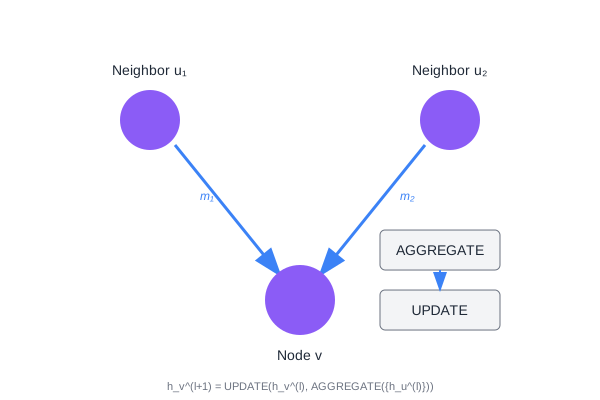
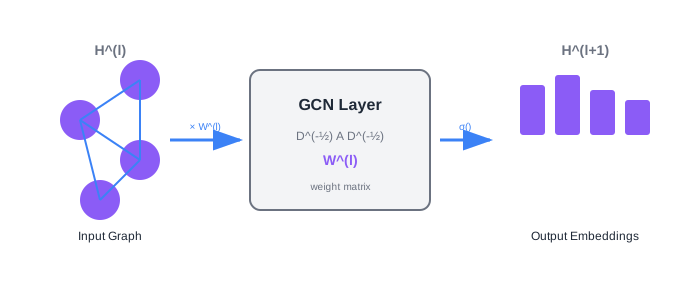
Graph Neural Networks are a class of deep learning methods designed to work directly on graph-structured data. Unlike traditional neural networks that operate on regular grids (images) or sequences (text), GNNs can process data with arbitrary graph topologies, making them ideal for:
Social Networks: Analyzing user connections and influence patterns
Molecular Structures: Predicting chemical properties and drug interactions
Knowledge Graphs: Reasoning over structured knowledge bases
G-Retriever: Retrieval-augmented generation with graphs
Graph-LLM: Integrating graph reasoning into LLMs
Text-Attributed Graphs: Combining textual and structural information
GNN-LLM Integration Paradigms (2024-2026)
The convergence of graph neural networks and large language models has produced novel architectures for leveraging both structural and textual information:
PromptGFM: Prompt-based graph foundation models enabling zero-shot transfer across diverse graph tasks without task-specific fine-tuning
LinguGKD: LLM-guided knowledge distillation frameworks that transfer reasoning capabilities from large models to compact GNNs for efficient deployment
Dual-Reasoning: Multi-modal graph-LLM synergy architectures where LLMs and GNNs iteratively refine each other's representations for complex reasoning tasks
GRIP: Graph-retrieval enhanced LLMs that ground language generation in external graph knowledge bases for knowledge-intensive tasks
Beyond Message Passing
Alternative propagation mechanisms addressing the limitations of traditional neighborhood aggregation:
Neural Graph Pattern Machine: Direct pattern counting and subgraph detection without iterative message passing, enabling O(1) inference for specific graph properties
Graph Wave Networks: Wave equation-based propagation models capturing oscillatory information flow and long-range dependencies through physical wave dynamics
Non-local GNNs: Global attention mechanisms and graph transformers bypassing local neighborhood constraints for direct long-range interactions
Scalable GNNs for Massive Graphs
New architectures and training paradigms for billion-node graphs and streaming scenarios:
ScaleGNN: Linear O(N) complexity algorithms achieving sublinear memory footprint through streaming computation and checkpoint-free training
SHAKE-GNN: Sublinear complexity via adaptive graph coarsening, dynamically selecting resolution based on query locality
Neural Scaling Laws: Empirical discovery that GNN performance scales logarithmically with graph size, enabling predictable performance for ultra-large graphs
Streaming GNNs: Online learning frameworks processing dynamic graphs with bounded memory, supporting continuous edge/node insertion without retraining
Hypergraph Neural Networks
Extending GNNs to high-order relationships beyond pairwise connections:
IHGNN: Inductive hypergraph learning architectures generalizing to unseen hyperedges and nodes in time-varying hypergraph structures
KHGNN: Knowledge-aware hypergraph reasoning combining semantic embeddings with hypergraph topology for complex relationship modeling
Dynamic Hypergraphs: Time-varying hyperedge structures capturing evolving group interactions in social, biological, and citation networks
Applications: Multi-way collaboration modeling, biological pathway analysis, group recommendation systems
HopNet: Fixed-depth O(1) layer architectures achieving global reachability through adaptive message routing, eliminating depth-depth tradeoffs
Adaptive Depth: Input-dependent computation graphs where network depth adapts to structural complexity rather than using fixed layers
Spectral Methods: Chebyshev polynomial approximations and adaptive frequency filtering for efficient spectral graph convolutions without eigen-decomposition
Expressiveness Limits: Beyond Weisfeiler-Lehman tests using higher-order logical expressiveness and positional encodings for distinguishing structurally unique graphs