Three Bugs That Blocked OpenCloud OIDC Login — A Debugging War Story
🇩🇪 Auf Deutsch lesen~6 min read
DevOpsopencloudopenldapoidckeycloakkuberneteshelmdebuggingldapshibboleth
Back openDesk Edu for a sovereign, open-source education — every vote counts.
Vote nowSave products you love by clicking the heart icon.
Complete Helm command reference covering charts, releases, repositories, values, and release management.
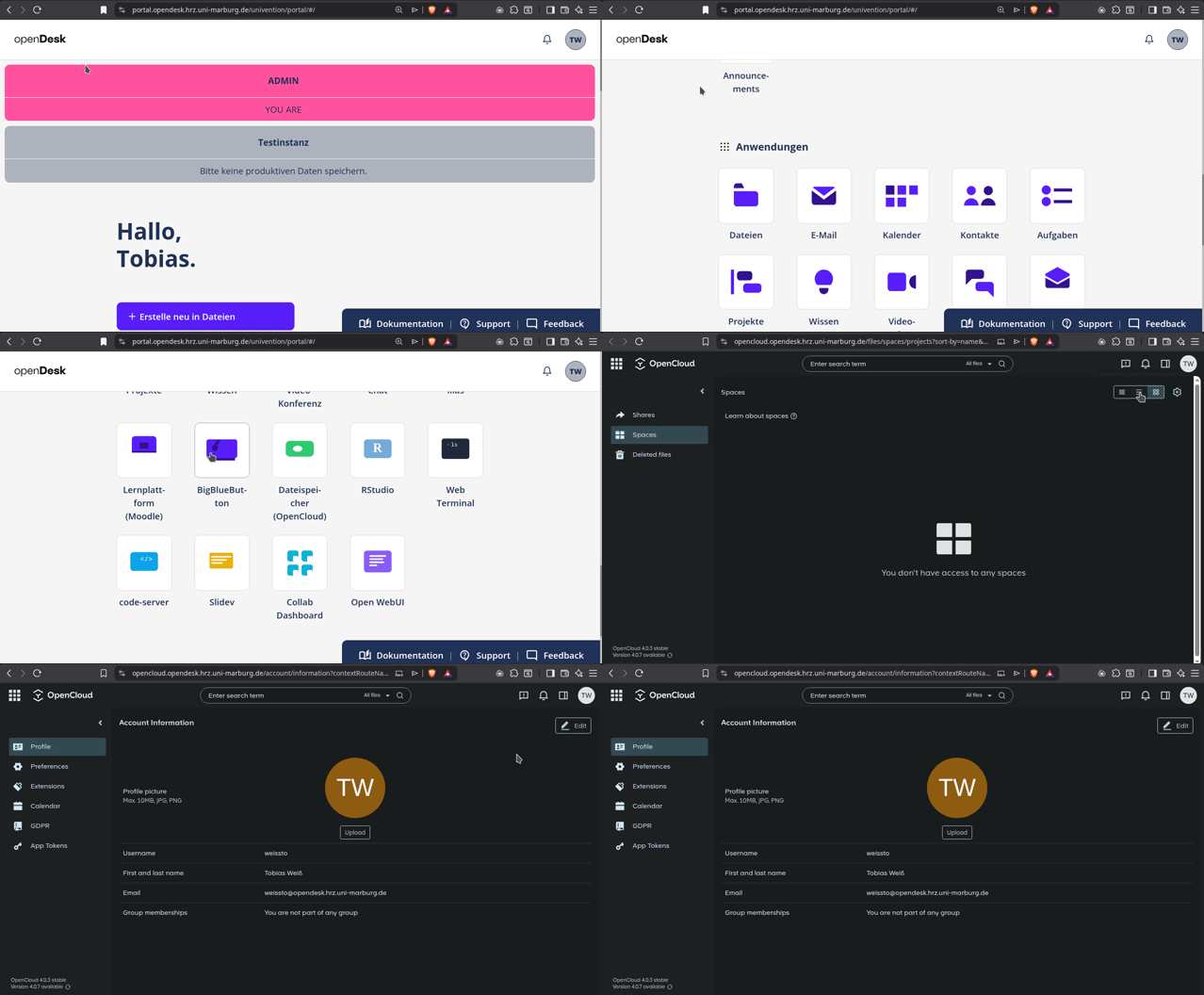
After a user auto-provisioned via Keycloak OIDC is successfully created in LDAP, OpenCloud's proxy can't issue a session token. The user sees "Sie werden eingeloggt" followed by "Nicht angemeldet". Every. Single. Time.
This is the story of how three independent bugs stacked to create that failure — and what it took to find them.
OpenCloud 4.0.3, deployed via Helm on Kubernetes, configured with an external UMS LDAP (OpenLDAP) as the identity backend. Users authenticate through Keycloak/Shibboleth via OIDC. Auto-provisioning is enabled: when a user logs in for the first time, OpenCloud creates their LDAP entry on the fly.
The error was consistent and reproducible:
https://opencloud...The OpenCloud logs showed a clear pattern:
graph:   failed to add user → LDAP Result Code 68 "Entry Already Exists"
graph:   could not create user: backend error → nameAlreadyExists
proxy:   Error Response → OData Error: a user with that name already exists
proxy:   Error getting token for autoprovisioned user → user not found
The auto-provision flow was:
Every login attempt hit a wall. And the user DID exist in LDAP. Three independent bugs were responsible.
EQUALITY on openCloudUUIDThe auto-provision code searches LDAP for an existing user by UUID before creating one. The user existed — but the search returned zero results.
Testing the LDAP search directly:
$ ldapsearch ... "(openCloudUUID=*)"
→ returns the entry (presence check works)

$ ldapsearch ... "(openCloudUUID=b7ada882-...)"
→ returns 0 entries (equality check FAILS)
The attribute existed. The value was correct. But equality matching didn't work.
The openCloudUUID attribute type in the OpenLDAP schema was loaded without an EQUALITY rule:
olcAttributeTypes: ( 1.3.6.1.4.1.99999.1.1
  NAME 'openCloudUUID'
  SYNTAX 1.3.6.1.4.1.1466.115.121.1.15
  SINGLE-VALUE )

# Configmap definition (correct):
olcAttributeTypes: ( 1.3.6.1.4.1.99999.1.1
  NAME 'openCloudUUID'
  EQUALITY caseIgnoreMatch          ← MISSING from loaded schema!
  SYNTAX 1.3.6.1.4.1.1466.115.121.1.15
  SINGLE-VALUE )
Without EQUALITY caseIgnoreMatch, OpenLDAP can't perform equality matching on the attribute. The LDAP schema job only checked for the presence of new attribute OIDs — it never verified that existing attributes had correct matching rules. So when an old schema was loaded (from an earlier chart version that lacked EQUALITY), subsequent upgrades never fixed it.
EQUALITY rule to the running OpenLDAP via ldapmodify:ldapmodify -Y EXTERNAL -H ldapi:/// <<'EOF'
dn: cn={53}opencloud,cn=schema,cn=config
changetype: modify
replace: olcAttributeTypes
olcAttributeTypes: ( 1.3.6.1.4.1.99999.1.1 NAME 'openCloudUUID'
DESC 'OpenCloud user UUID'
EQUALITY caseIgnoreMatch
SYNTAX 1.3.6.1.4.1.1466.115.121.1.15 SINGLE-VALUE )
olcAttributeTypes: ( 1.3.6.1.4.1.99999.1.2 ... )
olcAttributeTypes: ( 1.3.6.1.4.1.99999.1.3 ... )
olcAttributeTypes: ( 1.3.6.1.4.1.99999.1.4 ... )
EOF
EQUALITY on openCloudUUID, not just the presence of attribute OIDs.After fixing the UUID search, the LDAP lookup still returned zero results — but this time the reason was buried in the search filter.
The reva LDAP user provider builds a search filter for GetUserByClaim("userid", uuid). By tracing through the OpenCloud source code, the filter construction was:
filter = fmt.Sprintf("(&%s(objectclass=%s)(%s=%s)%s%s)",
    i.User.Filter,
    i.User.Objectclass,           // "openCloudUser"
    attribute,                    // "openCloudUUID"
    value,                        // "b7ada882-..."
    i.tenantFilter(tenantID),     // ""
    i.disabledFilter(),           // "(!(openCloudUserEnabled=FALSE))"
)
The resulting filter:
(&(objectclass=openCloudUser)(openCloudUUID=b7ada882-...)(!(openCloudUserEnabled=FALSE)))
Testing it directly:
$ ldapsearch ... "(&(objectclass=openCloudUser)(openCloudUUID=b7ada882-...))"
→ 1 entry found

$ ldapsearch ... "(&(objectclass=openCloudUser)(openCloudUUID=b7ada882-...)(!(openCloudUserEnabled=FALSE)))"
→ 0 entries found
LDAP uses three-valued logic: TRUE, FALSE, and UNDEFINED. When an attribute doesn't exist on an entry:
(attr=FALSE) → UNDEFINED (the attribute isn't present, so the comparison can't be evaluated)(!(attr=FALSE)) → NOT(UNDEFINED) → UNDEFINED(TRUE AND TRUE AND UNDEFINED) → UNDEFINED → entry is not returnedThe user entry in the external UMS LDAP didn't have an openCloudUserEnabled attribute. This is an OpenCloud-internal attribute that doesn't exist in the external LDAP. The disabledFilter() was designed for OpenCloud's internal IDM LDAP (which has this attribute), but when pointed at an external LDAP, it silently filtered out every user.
The DisableUserMechanism was set to "attribute" by default, which adds the (!(openCloudUserEnabled=FALSE)) filter. In OpenCloud's internal IDM, every user has this attribute set to TRUE. In an external LDAP, nobody does.
# values.yaml
oidc:
  roleAssignmentDriver: "default"

# → sets env var OC_LDAP_DISABLE_USER_MECHANISM=none
Setting OC_LDAP_DISABLE_USER_MECHANISM=none tells the users service to skip the disabled filter entirely. This is the correct setting when using an external LDAP that doesn't manage OpenCloud-specific attributes.
After fixing the LDAP search, the login flow progressed further — but failed with a new error:
proxy: no roles in user claims
proxy: Error mapping role names to role ids → oidcroles.go:84
proxy: Could not get user roles → account_resolver.go:192
The proxy was configured with PROXY_ROLE_ASSIGNMENT_DRIVER=oidc, which reads role information from OIDC claims and maps them to OpenCloud roles. Our Keycloak instance doesn't send roles in the OIDC token — it's a simple authentication-only setup.
The OIDC role mapper iterates over the claims, looks for roles, finds none, and returns an error. This error propagates up through the account resolver, which aborts the login.
I initially tried GRAPH_ASSIGN_DEFAULT_USER_ROLE=true, which controls whether the Graph API assigns a default role when creating users. But the error was coming from the Proxy after user creation, during token issuance. Two different code paths, two different env vars.
The PROXY_ROLE_ASSIGNMENT_DRIVER supports two values:
| Driver | Behaviour |
|---|---|
oidc | Reads roles from OIDC claims. Fails if claims have no roles. |
default | Assigns the role "user" to any user without a role at login time. |
The oidc driver is designed for setups where Keycloak sends roles via an OIDC claim (e.g., roles, groups, or a custom mapper). When used with a Keycloak that doesn't send roles, it's a hard blocker.
# values.yaml
oidc:
  roleAssignmentDriver: "default"

# → sets env var PROXY_ROLE_ASSIGNMENT_DRIVER=default
The default driver checks if the user already has a role assigned. If not, it assigns the built-in "user" role. This is the correct choice for most simple OIDC setups.
Here's how the three bugs interacted:
User authenticates via OIDC
  ↓
Proxy calls GetUserByClaims("userid", uuid)
  ↓
Gateway delegates to users service (LDAP backend)
  ↓
Bug #1: LDAP schema → UUID equality search returns 0 entries
Bug #2: disabledFilter → existing user silently excluded from results
  ↓
GetUserByClaims → ErrAccountNotFound
  ↓
Proxy calls CreateUserFromClaims → Graph API → LDAP add → "Entry Already Exists"
  ↓
Cloud returns nameAlreadyExists → CreateUserFromClaims re-reads user → returns user
  ↓
Proxy calls GetUserByClaims again → STILL ErrAccountNotFound (bugs 1 & 2 again)
  ↓
Proxy falls through → tries role assignment
Bug #3: OIDC driver → no roles in claims → error
  ↓
"No roles in user claims" → 401 → "Nicht angemeldet"
Each bug alone would have been survivable in a different configuration:
But together, they created a perfectly impenetrable wall.
Verify LDAP schema equality rules. Presence checks (attr=*) can work fine while equality checks (attr=value) silently fail. Always test both.
LDAP's three-valued logic is not intuitive. (!(attr=FALSE)) is NOT a no-op for absent attributes — it's UNDEFINED, which excludes entries from search results. If you're adding a "disabled" filter, make sure every user actually has the attribute.
Know which service owns which env var. GRAPH_ASSIGN_DEFAULT_USER_ROLE (Graph API, during user creation) and PROXY_ROLE_ASSIGNMENT_DRIVER (Proxy, during login/token issuance) control different stages of the same flow. Fixing the wrong one changes nothing.
Always re-test after each fix. Debugging three stacked bugs is only feasible if you verify each fix independently before moving to the next. The error messages changed at each step — confirming each fix independently.
All three fixes have been contributed upstream in OpenCloud revision 50, with chart templates updated to prevent recurrence on future deployments.